


IoT Temperature and Humidity Monitoring System using ESP32
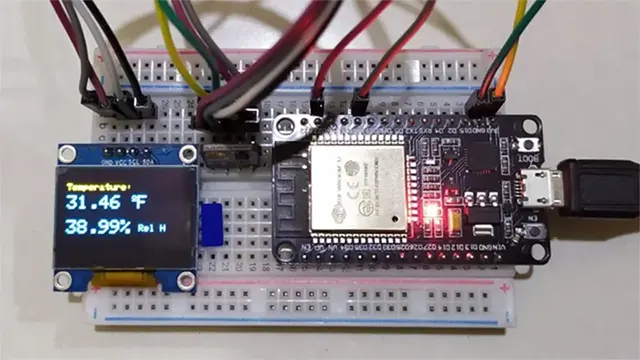
The brain of your project is the ESP32-WROOM-32. It is a powerful, dual-core microcontroller that is much faster than a standard Arduino and comes with built-in wireless features.
- Processor: Dual-core Xtensa® 32-bit LX6 (Adjustable from 80 MHz to 240 MHz).
- Wireless: Integrated Wi-Fi (802.11 b/g/n) and Bluetooth (Dual-mode: Classic + BLE).
- Memory: 520 KB SRAM and typically 4 MB Flash storage.
- Pins: 38 pins including capacitive touch sensors, Hall sensors, ADC, DAC, and I2C/SPI interfaces.
- Voltage: Works at 3.3V, though the board can be powered by 5V via the Micro-USB port.
0.96" OLED Display (SSD1306)
The screen is a monochrome (usually blue or yellow/blue) organic LED display. Unlike standard LCDs, it doesn't need a backlight, making it very crisp and power-efficient.
- Size: 0.96 inch.
- Resolution: $128 \times 64 pixels.
- Controller IC: SSD1306.
- Interface: I2C (uses only 4 pins: VCC, GND, SCL, SDA).
- Viewing Angle: Greater than 160° (visible from almost any side).
- Display Color: The yellow top section and blue bottom section are fixed in the hardware of this specific module.
DHT11/DHT22 Sensor (Climate Sensor)
This sensor measures the surrounding air and provides a digital signal on a single wire.
- Function: Measures Temperature and Relative Humidity.
- Operating Voltage: 3V to 5.5V.
- Accuracy (DHT11): pm 2 °C for temperature and pm 5% for humidity.
- Accuracy (DHT22): pm 0.5 °C for temperature and pm 2% for humidity.
- Data Signal: Single-bus digital signal.
Prototyping Gear
- Breadboard: A 400-point solderless breadboard used for temporary circuit connections.
- Jumper Wires: Male-to-Male (M-M) wires used to connect the ESP32 to the display and sensor.
- Micro-USB Cable: Used for both uploading the code and providing power to the system.